

Experion helps Australian aged care operators cut through operational complexity with custom retirement living software, so care teams spend less time on administration and more time with residents.
Managing a retirement living community in Australia has rarely been more demanding. The Aged Care Act 2024 has reset compliance expectations overnight. The AN-ACC funding model has changed how operators get paid. Staffing costs keep rising. And families want real-time updates on their loved ones, not a weekly phone call from a coordinator.
Most operators are managing all of this on systems that were never built for it. Spreadsheets. Paper medication records. Billing processes that depend entirely on someone remembering to write something down after a busy shift.
Retirement living software is designed to solve this by connecting existing workflows.
This includes care documentation, billing, compliance reporting, and family communication. Information flows where it needs to go without any manual updation.
Key Takeaways
- Retirement living software is an end-to-end operational platform for senior care communities. It encompasses care management, billing, compliance, rostering, and family engagement in one integrated system.
- Australia’s regulatory landscape comprises the Aged Care Act 2024, AN-ACC funding, ACQSC audit requirements, and My Aged Care integration. This makes customized senior living software solutions considerably more practical than adapting generic healthcare IT tools.
- The best retirement living software combines strong clinical management with mobile access for frontline staff, automated billing, and real-time reporting for administrators.
- Effective platform selection starts with a clear understanding of your community type and operational pain points.
What Is Retirement Living Software?
Defining Retirement Living Software
Retirement living software is a platform built specifically to manage the operations of a senior care community. That scope covers resident intake and care planning, medication management, staff rostering, billing, regulatory documentation, and family communication. All of these functions are ideally within a single connected system.
The distinction between retirement living software and a general healthcare IT platform is more significant than vendors sometimes acknowledge. Aged care has its own workflows, funding structures, and compliance requirements. Platforms designed for acute hospital care address fundamentally different problems. When operators attempt to adapt those tools for aged care, they spend considerable time working around the gaps. These are where errors tend to occur.
Looking to modernize your retirement living operations? ⟶
Talk to our experts to see how a custom solution can fit your workflow.
How Senior Living Software Works?
A senior living software platform follows the resident from before they arrive. Inquiry tracking, pre-admission assessments, and digital documentation are captured at the outset, feeding directly into a care plan on move-in day rather than requiring manual re-entry.
From that point, daily clinical activity is recorded at the point of care – medication passes, vital signs, incidents and Activities of Daily Living (ADL) observations. That documentation automatically feeds into billing at month-end and into compliance reporting at quarter-end.
On the operations side, rostering tools manage shift coverage, maintenance requests are tracked from submission to completion, dining preferences are accessible in the kitchen, and administrators have a live view of occupancy and care quality metrics without having to assemble a manual report.
Retirement Living App vs. Desktop Platform
The shift to mobile documentation in aged care reflects a practical reality: a care worker returning to the nurse’s station to record a medication pass is not providing direct care during that time.
A well-designed retirement living app brings documentation to the point of care. Vital signs can be recorded at the bedside, incidents reported from wherever they occur, and family messages sent without leaving the floor. Administrators continue to rely on the desktop experience for reports, rostering configuration, and billing management.
The best retirement living app experiences deliver both – a fast mobile interface for frontline staff and a comprehensive desktop platform for management. Both need to be synchronized in real time.
The State of Retirement Living in Australia
The ABS projects that Australians aged 65 and over will represent approximately 23% of the population by 2066, up from around 16% today. Demand for retirement living and aged care services will grow accordingly, and the sector is already under considerable operational strain.
Workforce pressure is the most immediate challenge most operators are managing. Aged care has high turnover, significant reliance on agency staff, and a recruitment pipeline that has not kept pace with demand. Every hour a qualified care worker spends on administrative tasks rather than direct care represents a real cost.
The Royal Commission into Aged Care Quality and Safety identified inadequate documentation systems, poor data sharing between care teams, and manual processes as direct contributors to poor resident outcomes.
Why Australian Aged Care Providers Need Modern Retirement Living Software Solutions?
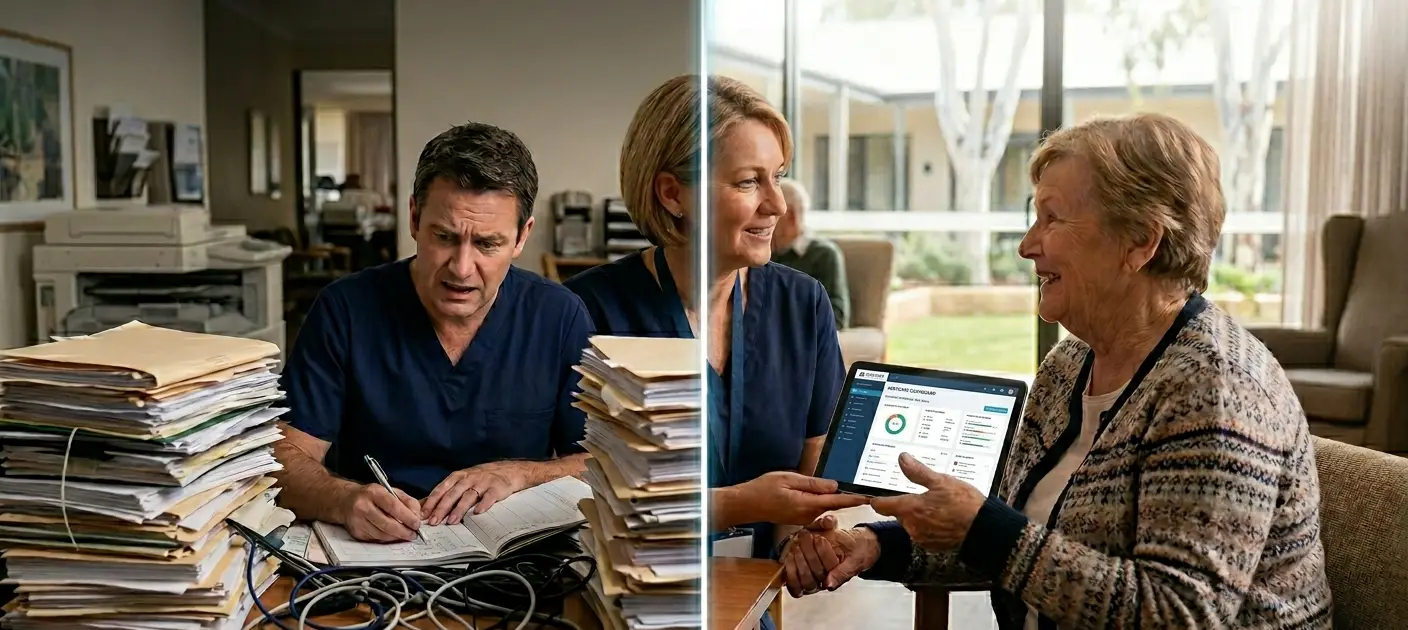
- Improving Resident Outcomes: When care teams have accurate, current information at the point of care, clinical decisions will improve. A practical example includes recording three months of weight trend data on a tablet rather than a paper file from last week.
- Operational Efficiency: Operations management software for retirement living targets the administrative load that contributes to staff burnout. Rostering tools can identify understaffing before a shift begins. Maintenance tracking that does not depend on verbal handoffs. Billing automation that captures every chargeable service systematically. These capabilities change how a community runs on a daily basis.
- Regulatory Compliance: Meeting compliance requirements under Australia’s aged care framework demands complete documentation. The best assisted living software platforms embed compliance into daily workflow. Instead of being treated as a separate administrative function, it can track complete audit trails, structured incident reporting, and care plan version history.
Types of Retirement Living Software Platforms
Standalone Assisted Living Software
Standalone assisted living software focuses on clinical and care functions: medication management, care planning, ADL tracking, and incident reporting. It is a practical entry point for single-site operators seeking to strengthen care documentation and compliance.
The primary limitation is integration. Standalone tools rarely connect effectively with billing, HR, or family engagement systems, which means data continues to exist in silos and staff continue to enter the same information in multiple places.
Integrated Senior Living Software Platforms
Integrated platforms bring operations, finance, clinical care, and resident engagement into a single system. For multi-site operators and larger aged care groups, this is where the greatest operational value lies. Regional managers have a consolidated, current view across all communities. Billing draws directly from documented care. Care protocols are standardized across sites without manual coordination.
Implementation timelines are longer, and the initial investment is higher. However, operators who have completed the transition consistently report payback periods shorter than anticipated.
Hybrid and Modular Senior Living Software Solutions
Modular platforms allow operators to begin with the capabilities they need most and add functionality over time. A community might start with care management and billing, then add family engagement, workforce management, and analytics as organizational needs develop.
This approach suits providers who want to modernize incrementally rather than undertake a full platform replacement in a single implementation.
It also works well for operators running mixed care models – independent living, assisted living, and memory care under one roof – where different modules serve genuinely different operational requirements.
| Feature | Standalone | Integrated | Hybrid/Modular |
| Best For | Single-site operators | Multi-site groups | Growing providers |
| Setup Time | 4–8 weeks | 4–9 months | 2–4 months |
| Cost Profile | Lower upfront | Higher upfront | Scalable |
| AN-ACC Support | Partial | Full | Full |
| ROI Timeline | Moderate | 12–18 months | 6–12 months |
Key Features of the Best Retirement Living Software
Care and Clinical Management
The clinical module is where the daily work takes place. Core features include:
- Medication Administration Records (MAR)- Digital tracking of every medication pass with alerts for missed or delayed doses. eMAR integration measurably reduces transcription errors.
- Care Plan Management- Creation and real-time updating of individualized care plans with version history maintained for audit purposes. Plans are accessible to every care team member at the point of care.
- Incident and Fall Reporting- Structured incident documentation with automatic notification workflows for supervisors and, where required, the Aged Care Quality and Safety Commission (ACQSC).
- ADL Tracking- Tracks the Activities of Daily Living (ADL) to support accurate care level assessments and AN-ACC funding claims.
Operations Management Software Retirement Living
Clinical quality depends on sound operational infrastructure.
The operations layer of a senior living platform covers rostering and shift management. Tools identify understaffing before it affects care delivery alongside maintenance tracking, dining coordination, and housekeeping scheduling.
The best retirement living management software integrates these functions rather than treating them as separate tools requiring manual reconciliation.
Still relying on spreadsheets and disconnected systems? ⟶
Contact our team for the state-of-the-art retirement living software solutions.
Billing, Finance, and AN-ACC Funding Claims
Billing in Australian aged care is complex, and the transition to the Australian National Aged Care Classification (AN-ACC) has added layers of specificity that manual processes struggle to manage consistently. AN-ACC determines the extent of funding an aged care home receives for each resident.
The funding claims require accurate clinical documentation to support correct resident classification and the corresponding government subsidy. Private billing for retirement living involves rent, care fees, and additional services that change as residents’ needs evolve.
Software that connects care documentation directly to billing output eliminates revenue leakage caused by undocumented services. Every delivered service is captured, and every AN-ACC assessment feeds into the funding claim.
The result is faster billing cycles and substantially fewer errors.
Resident and Family Engagement
Family access to real-time updates on a resident’s daily life has become a standard expectation rather than a differentiator.
Core features include family communication portals, activity updates, health summaries, and digital move-in documentation. The best retirement living app also gives residents direct access to meal bookings, activity registrations, and maintenance requests. This reduces the staff’s time spent managing routine requests.
Analytics and Reporting
Occupancy trends, billing performance, staff utilization, care quality metrics, and incident frequency should all be accessible through a dashboard without requiring anyone to compile them manually.
For multi-site operators, consolidated reporting across communities is among the most compelling practical arguments for investing in integrated senior living software.
Compliance & Reporting
In Australian aged care, compliance reporting means maintaining complete documentation for ACQSC audits, generating required reports for the Department of Health and Aged Care, and retaining records capable of withstanding regulatory scrutiny. Platforms that integrate compliance tracking into standard daily workflows make audit preparation routine. Those who do not make it a reactive exercise.
Experion brings over 20 years of product engineering expertise to Australian aged care providers, helping operators build, deploy, and scale senior living software solutions that improve resident outcomes, reduce care team burden, and meet the compliance requirements of the Aged Care Act 2024.
Aged Care Compliance in Australia: What Your Software Must Support
For Australian operators, compliance is a non-negotiable operational requirement. Any retirement living software under consideration must address the following:
- Aged Care Act 2024: The Act strengthens the rights of older Australians and imposes material obligations on providers regarding care quality, governance, and transparency. Software must support the documentation and reporting requirements introduced by the Act, including strengthened incident management and care planning obligations. Vendors should be able to demonstrate specific Act readiness.
- ACQSC audit readiness: The Aged Care Quality and Safety Commission conducts both scheduled and unannounced audits against the Aged Care Quality Standards. Complete, timestamped, digitally accessible care records make audit preparation a systematic process rather than a reactive one.
- AN-ACC billing and funding: The Australian National Aged Care Classification determines a resident’s care category and the corresponding government subsidy. Software that connects assessment data directly to funding claims reduces classification errors and improves the consistency and speed of subsidy receipt.
- My Aged Care integration: My Aged Care is the primary entry point for government-funded aged care services in Australia. An effective platform should receive referrals, share care information, and update service records through My Aged Care without requiring manual data re-entry.
- Australian Privacy Principles: Australian aged care providers operate under the Privacy Act 1988 and the Australian Privacy Principles (APPs), not HIPAA. Vendor discussions about data security and compliance should specifically address APP obligations, particularly regarding the collection, use, and storage of sensitive health information.
Ready to build a senior living app tailored to your community? ⟶
Connect with us.
Benefits of Senior Living Software for Australian Operators and Residents
- Reduced Administrative Burden: Care workers across Australian aged care spend a significant proportion of each shift on documentation. Purpose-built software reduces that time, freeing it for direct resident care.
- Improved Care Consistency: When care plans are current, digital, and accessible to every team member at the point of care, the margin for error narrows across medication administration, care interventions, and incident responses.
- Real-Time Visibility Across Communities: Multi-site operators with access to current occupancy, billing status, staffing levels, and care quality metrics across their portfolio make better decisions faster.
- Faster Billing Cycles: Automated charge capture connected to care documentation produces invoices more quickly and with fewer errors. AN-ACC claims reflect accurate assessment data. Revenue leakage from undocumented services is significantly reduced.
- Enhanced Family Trust: Families who receive proactive communication and have direct access to their loved one’s activity and health information are better informed and less likely to escalate concerns. The downstream effect on reputation, referrals, and occupancy is measurable.
- Regulatory Audit Readiness: Complete digital documentation, automatic audit trails, and structured compliance reporting mean ACQSC surveys are manageable rather than operationally disruptive.
Challenges in Adopting Retirement Living Software
Implementing any new platform comes with friction. In senior living, the challenges are distinct:
- Staff Adoption Across a Mixed Workforce. Aged care employs people across a broad range of technology experience. A platform that administrators find intuitive may present a difficulty for personal care workers with limited digital experience. Usability and structured training investment are as important as platform capability.
- Data Migration from Legacy Systems. Transferring historical resident records, care plans, and medication histories from paper or older platforms requires careful planning and quality control. This stage is consistently underestimated, and that underestimation is one of the most common reasons implementations exceed their timelines and budgets.
- Integration with Existing Systems. Many communities maintain payroll, accounting, or EHR tools that they are not replacing. API architecture and pre-built connectors, particularly for My Aged Care and AN-ACC billing, warrant careful evaluation rather than acceptance of general vendor assurances.
- Budget Constraints. For independent operators and smaller communities, enterprise senior living software solutions present a significant financial commitment. Modular platforms and SaaS pricing models have improved accessibility, but total cost of ownership should be assessed from the outset.
Industry Applications: Where Senior Living Software Delivers the Highest ROI in Australia
Assisted Living Facilities
Assisted living operators face the highest compliance requirements and the most direct scrutiny from ACQSC. Custom assisted living software reduces compliance risk by making complete documentation a product of daily routine. Medication error rates decline with eMAR adoption. Moreover, incident response improves when reporting is immediate and structured.
Independent Retirement Communities
In independent living, the operational priorities shift from clinical compliance to lifestyle and amenity management. Software for these communities supports activity coordination, dining preferences, maintenance management, and family communication.
A well-designed senior living app that gives residents direct control over bookings and requests improves satisfaction.
Memory Care Communities
Memory care requires software capabilities that most platforms do not develop natively. Behavioral tracking, integration with door sensors and wander management systems, and communication tools designed for families navigating a complex situation need to be built specifically for memory care. Operators running dedicated memory care communities should verify how a vendor’s platform addresses this care model directly.
Multi-Site Australian Aged Care Groups
Operators managing multiple communities, centralized operations management software transforms regional oversight from a coordination-intensive exercise into a data-driven management function. Standardized care protocols are deployed across sites from a single configuration. Regional directors access current performance data across the portfolio in real time. AN-ACC funding performance can be monitored and acted on without waiting for community-level reporting cycles.
Integration with Other Systems
Modern Retirement Living Software cannot operate in isolation; it is seamlessly integrated with other critical systems.
- Electronic Health Records (EHR): Integration with EHR records is crucial. It ensures that the resident’s medical histories, treatment plans, and clinical data are always accessible at the point of care.
- CRM systems: Connecting with CRM Systems provide a more personalized experience. It allows the provider to manage the entire lifecycle with a unified workflow. From initial inquiry and admission to ongoing engagement, everything can be tracked to manage the entire resident lifecycle.
- IoT and smart devices (fall detection, health monitoring): Integration with IoT and smart devices, such as fall detection sensors, wearable health monitors, and remote patient monitoring tools, enables real-time data to flow directly into the system. This supports proactive care by alerting staff to potential risks before they escalate, enhancing both safety and quality of care in assisted living software platforms.
- Payment gateways and banking systems: Additionally, integrating with payment gateways streamlines financial operations by enabling automated billing, secure transactions, and faster payment reconciliation. This reduces administrative burden while improving accuracy and transparency in financial management.
How to Choose the Best Assisted Living Software Platforms for Your Australian Community?
Define Your Operational Priorities First
Before engaging vendors, clearly identify where your most significant operational problems lie. Care documentation and compliance? AN-ACC billing accuracy? Family communication? Staff rostering? The answer determines which platform capabilities matter most.
Map your community model to the platform’s core capabilities. Platforms designed for the US markets may not support My Aged Care integration or AN-ACC billing. Platforms designed for acute hospital care are structurally misaligned with aged care workflows.
Must-Have Criteria for Evaluating Senior Living Software Platforms
- Regulatory compliance: Vendors should demonstrate specific experience with Australian aged care compliance: Aged Care Act 2024 readiness, AN-ACC billing support, and ACQSC audit trail capabilities
- Integration capabilities: Establish all of your integration requirements before evaluating any platform. Requirements may include Rostering Tools, MyAged Care, Accounting systems etc.
- Mobile experience: The frontline workers should evaluate the retirement living app under realistic working conditions.
- Vendor support: Assess implementation structure and the post go-live support offered by the vendor.
- Scalability: If you have growth plans, confirm that the platform accommodates higher residential volumes and additional communities without triggering a new implementation each time.
Questions to Ask Every Vendor
- How is our resident data stored, secured, and backed up? Does the platform comply with the Australian Privacy Principles under the Privacy Act 1988?
- What is the realistic implementation timeline, and what do you need from our team to hit it?
- How does the platform specifically support AN-ACC billing and My Aged Care integration?
- What does the post-go-live support model look like over the first 90 days?
- Can you provide documented case studies from Australian aged care communities of comparable size and care model?
Common Mistakes When Selecting Retirement Living Software
- Choosing based on demo quality: A good demonstration reflects a vendor’s strengths, not your operational reality. A pilot using actual data and workflows is the appropriate basis for a procurement decision.
- Ignoring staff usability: Procurement decisions made at the administrative level without frontline input regularly lead to adoption problems after go-live.
- Underestimating integration complexity: Connecting a new platform to existing billing, EHR, and payroll systems consistently takes more time than initial estimates suggest.
- Choosing a platform without a dedicated senior care vertical: General healthcare IT platforms can be configured for senior living, but the workarounds add friction.
How Custom Retirement Living Software Development Can Help?
- Tailored solutions for Australian retirement communities: Off-the -shelf platforms cannot fully align with the operational realities. When an Australian aged care provider tries to run their community on software designed for a hypothetical average operator, something always gets left out. This could be a workflow that does not quite fit or a compliance requirement the vendor has not prioritized. Custom retirement living software starts from the opposite direction. Rather than adapting operations to fit a generic tool, the system is built around how the community actually works.
- Integration with existing infrastructure: Integration is where custom development earns its cost most clearly. The average Australian aged care operator already has accounting tools, payroll systems, EHR platforms, and government portals like My Aged Care. Off-the-shelf platforms connect to these systems with varying degrees of success, and the gaps between them become manual data entry tasks that accumulate across every shift. A custom solution is built to make these connections properly.
- Flexibility to adapt to changing regulations: Adaptability to changing regulations is another practical argument. The compliance landscape is not stable. A custom-built system can be modified to meet new requirements as they arrive.
- Long-term ROI and scalability: The long-term ROI case is straightforward. As operators grow, the software grows alongside them. There is no point at which the platform becomes a constraint that requires replacement. For providers thinking beyond the next 12 months, that is not a minor consideration. It is the difference between a technology purchase and a strategic asset.
Enhancing the Resident Experience with a Senior Living App
A well-designed senior living app serves as both a resident amenity and an operational efficiency mechanism. Residents who can manage meal bookings, activity registrations, maintenance requests, and staff communication independently place fewer routine demands on frontline staff.
Features of the best retirement living app
Key capabilities include
- Adjustable text sizing and high-contrast display options
- Offline functionality for areas with inconsistent connectivity
- Real-time push notifications for families
- Point-of-care documentation tools for clinical staff
- Clear booking and scheduling interfaces for residents.
Social engagement is an area worth deliberate investment. Social isolation is among the most significant health risks in retirement living communities. Apps that surface activity options, facilitate connections between residents with shared interests, and keep families informed of daily community life address that risk.
The Future of Assisted Living Software Platforms
- AI-powered care alerts: Predictive Analytics can identify residents at risk of falls, hospitalization and clinical deterioration. The data for this analysis can be obtained from ADL trends, vital signs, and behavioral patterns.
- Wearable and remote monitoring integration: The next generation of retirement living software will incorporate data from wearable health monitors, bed sensors, and environmental devices directly into care plans. This supports a transition from reactive to preventive care delivery.
- Voice-assisted documentation: Voice interfaces enabling nurses to dictate care notes at the point of care are entering production in leading platforms. The time reduction in documentation is material, particularly for clinical staff carrying heavy documentation loads.
- Generative AI for documentation support: AI tools that produce draft shift handover notes, care plan updates, and incident reports from structured data are beginning to appear in market-leading platforms. The purpose is not to replace clinical judgment but to remove the clerical workload.
- My Aged Care system evolution: As the Australian Government continues to develop My Aged Care’s digital infrastructure, integration between retirement living software and the government portal will become a standard operational expectation. Operators who build this capability now are better positioned for the regulatory and operational requirements ahead.
Conclusion
Retirement living in Australia is undergoing a massive shift. New legislation, increasing workforce costs, reformed funding models , and higher family expectations.
The focus is often on the property and people. But there is a growing discussion on procedures, practices, and processes. Well-implemented retirement living software does not resolve every challenge a community faces. It does, however, remove the administrative friction that compounds those challenges.
When evaluating platforms, the evaluation framework for Australian operators is clear: AN-ACC billing support, ACQSC audit readiness, My Aged Care integration, and compliance with Australian privacy requirements. Beyond those baseline requirements, vendor support quality, frontline usability, and integration capability with existing systems determine whether a platform delivers in practice what it demonstrates in procurement.
Frequently Asked Questions
- What is retirement living software?
A customized platform that manages retirement living community operations within a single connected system. These include resident care, billing, staff rostering, family communication, and regulatory compliance. - How does retirement living software improve senior living and care management?
Workflows in a senior care home are currently operating in silos. Care documentation can automatically provide data for billing. Rostering tools can identify understaffing even before the shifts begin. Family portals provide resident updates without consuming staff time. The overall result is consistent operations and reduced administrative overhead. - What is the difference between senior living software and assisted living software?
Senior living software covers the full range of community types. It includes but is not limited to independent living, assisted living, memory care, and mixed-model communities. Assisted living software refers specifically to platforms addressing the clinical and compliance requirements of assisted living. - What features should the best retirement living software include?
For Australian operators, the non-negotiable capabilities are AN-ACC billing support, My Aged Care integration, ACQSC audit trail functionality, mobile care documentation, family engagement tools, and compliance reporting aligned with the Aged Care Act 2024. - Why is operations management software important in retirement living communities?
Operational inefficiency increases costs and contributes to staff burnout. Operations management software automates the routine coordination that currently occupies supervisory and administrative capacity. - What are the benefits of using senior living software solutions?
Reduced documentation time for care staff, improved billing accuracy, real-time compliance visibility, stronger family satisfaction, and greater audit readiness are the benefits mostly reported by Australian aged care operators following implementation. - How do assisted living software platforms enhance senior care?
By giving care teams accurate clinical information at the point of care.
A nurse with access to a resident’s full medication history, recent vital signs, and active care plan on a mobile device is better equipped to make sound clinical decisions than one working from a paper file updated several days prior. - What should you consider when choosing the best assisted living software platforms?
To choose the best platform, begin with Australian regulatory requirements: AN-ACC billing support, My Aged Care integration, compliance with the Australian Privacy Principles, and Aged Care Act 2024 readiness. Then assess frontline usability, integration with existing systems, vendor support quality, and scalability for your growth plans. - Are there mobile apps available for senior living and retirement living management?
Yes. Most leading senior living software solutions include a retirement living app for frontline staff documentation and a separate portal for residents and families. Evaluating the mobile experience with frontline care staff under realistic working conditions is strongly advisable before committing. - What is the future of retirement living software solutions?
Such software solutions are moving towards AI-assisted, predictive care management. Platforms that identify clinical risks before incidents occur, integrate with wearable health monitoring devices, and apply generative AI tools to reduce documentation workload.
In Australia, deeper My Aged Care integration and alignment with aged care reform requirements will define the capabilities expected of leading platforms.
Experion’s senior living software solutions are designed to grow with Australian aged care providers, whether you operate a single retirement community or a portfolio of facilities across the country. To discuss the right platform for your community, contact our team.