

Experion works with enterprises on AI-powered demand forecasting- helping them anticipate demand shifts, manage supply chain risk, and make better decisions with their data.
Australian businesses have spent the past few years dealing with supply chain disruptions, inflationary cost pressures, and buying patterns that bear little resemblance to historical norms. Market volatility is no longer an exception to plan around; instead, it is the baseline. According to BCI, over 80% of supply chain leaders report higher disruption rates than in 2020, and half say they face material shortages every month. Traditional forecasting models built on historical data alone cannot keep pace with that environment.
AI-powered demand forecasting software has changed how businesses handle this. These systems use machine learning and predictive analytics to generate real-time forecasts, continuously adjusting as new data arrives. Businesses that have adopted them are responding to demand shifts faster and carrying less excess stock as a result.
This blog covers how AI demand forecasting works, its practical benefits for Australian businesses, common implementation challenges, the regulatory environment, and where the technology is heading.
Key Takeaways
- The Privacy Act 1988, the Voluntary AI Safety Standard, and sector regulators like the ACCC, TGA, and FSANZ all have direct implications for how Australian businesses deploy demand planning software. Compliance isn’t a post-launch task.
- Data quality is the most underestimated implementation challenge. Legacy system integration comes a close second.
- A five-phase roadmap -readiness check, data infrastructure, piloting, rollout, and ongoing governance – consistently produces better outcomes than jumping straight to deployment.
- Autonomous supply chains, generative AI planning tools, and IoT-fed forecasting are coming. The businesses with solid data foundations will adopt them faster.
What is Demand Forecasting and Demand Planning Software?
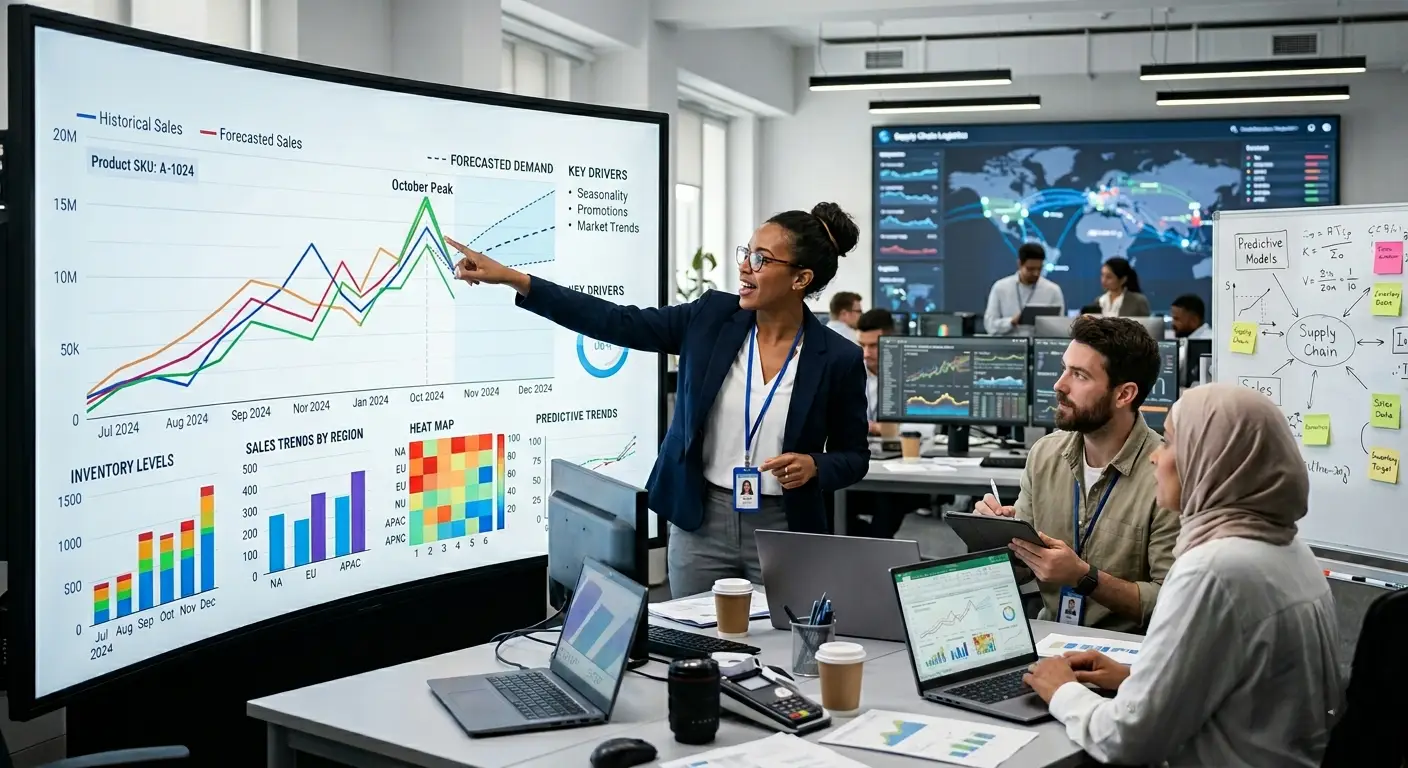
At its simplest, demand forecasting is the process of estimating how much of a product customers will want, and when. Accurately predicting your inventory levels leads to precise production schedules and proper cash flow. Get it wrong, and you’re either sitting on dead stock or running out of product at the worst possible time.
Australia adds its own complications. The population is spread across a continent, which means distribution logistics are expensive and lead times between major centers are long. Seasons run in the opposite direction to what most global software assumes. Supply chains depend heavily on international shipping routes, which means disruptions occurring 10,000 kilometers away can ripple through to Australian shelves within weeks.
Add state-based differences in public holidays, consumption patterns, and regulatory requirements, and you’ve got a demand planning environment that generic international platforms often handle poorly.
Demand planning and forecasting software built with these local conditions in mind is required.
Drawbacks of Traditional Demand Planning and Forecasting Approaches
Statistical models and spreadsheet-based planning worked well enough for decades. The problem is that the conditions for which they were designed have changed significantly
Over-Reliance on Historical Data in Traditional Demand Planning Software
Traditional demand planning software assumes the past repeats.
In Australia, cost-of-living pressures, extreme weather events, and international supply shocks have made that assumption risky. When conditions shift rapidly, historical models produce forecasts that are wrong in ways that cause real operational damage – overstock in some lines, stockouts in others.
Inability of Legacy Demand Planning Software Solutions to Process Large Datasets
Modern demand signals come from dozens of sources simultaneously: sales data, social media, weather feeds, competitor pricing, and economic indicators.
However, legacy demand planning software solutions were not built to process that volume or variety. Analysts working manually cannot either, which means large amounts of useful signal get ignored.
Slow Response Time in Manual Demand Forecasting and Planning Software
Monthly or quarterly forecasting cycles do not work when demand can shift within hours.
A weather event or a viral social post can move product faster than a manual planning cycle can detect. By the time the forecast updates, the opportunity or the problem is already half over.
High Human Error Risk Without Automated Demand Planning Software
Spreadsheet-based forecasting introduces error at every step.
This includes data entry mistakes, formula inconsistencies, and subjective adjustments that vary by analyst. Without automated demand planning software, those errors compound across planning cycles and are difficult to audit or trace.
Limited Scenario Planning in Basic Software for Demand Planning
Basic software for demand planning can produce a single forecast. It cannot simulate what happens when a key supplier goes down, a competitor exits a product category, or freight costs spike unexpectedly.
That inability to model uncertainty is a significant gap for Australian businesses trying to plan in conditions that change week to week.
These limitations are why AI-based forecasting has moved from a competitive advantage to a practical necessity for many businesses.
What Is AI-Powered Demand Forecasting?
AI-powered demand forecasting software uses machine learning and neural networks to analyse large datasets. Unlike traditional statistical models, these systems learn continuously from new data and adjust forecasts as conditions change, without requiring manual reconfiguration.
The data these systems draw on are the following, and they go well beyond historical sales records:
- Historical sales data and inventory levels
- Promotions and pricing history
- Seasonality patterns and weather data
- Macroeconomic indicators
- Social sentiment and search trend data
- Competitor pricing and availability signals
- Supply chain constraints and lead time variability
That breadth of input is why AI demand forecasting and planning software consistently outperforms statistical models on accuracy – particularly in volatile conditions where past patterns are a poor guide to near-term demand.
Not sure where to start with AI demand forecasting? Connect with our experts today!
How AI Demand Forecasting Software Works?
The mechanics of AI demand forecasting involve several distinct stages. Understanding them helps businesses assess whether their data infrastructure is ready and where the biggest preparation effort will be needed.
Data Collection and Integration
The Top AI demand forecasting software for business pulls data from ERP systems, CRM platforms, e-commerce channels, market intelligence tools, IoT sensors, and supplier databases. The goal is a unified, real-time view of the factors driving demand rather than relying on a single internal data source that captures only part of the picture.
Data Cleansing in Demand Planning Software Solutions
Raw data is rarely clean. Demand planning software solutions use machine learning to identify and correct errors, remove duplicates, and resolve inconsistencies across systems before any forecasting happens. Skipping this step consistently produces unreliable outputs regardless of how sophisticated the forecasting model is.
Feature Engineering in AI Demand Forecasting Software
The system identifies which external variables actually affect demand for a given product or category – public holidays, promotional calendars, regional weather patterns, and price sensitivity. For Australian businesses, this includes Southern Hemisphere seasonal patterns and state-level variations that differ from global defaults.
Model Training in AI-Powered Demand Planning Software
Deep learning models are trained on the cleaned, feature-enriched dataset to identify demand patterns at the SKU, category, and regional levels. AI-powered demand planning software tests multiple model architectures and selects the approach that performs best for each product and location combination.
Forecast Generation Using Demand Forecasting and Planning Software
The output goes beyond a demand number. Demand forecasting and planning software generates safety stock recommendations, inventory replenishment plans, production requirements, and logistics inputs. These are all tied to current conditions rather than a fixed planning calendar. That makes it a decision-support tool and not just a forecasting engine.
Benefits of AI-Powered Demand Forecasting Software in Australia
The operational, financial, and strategic benefits of AI demand forecasting are well documented. Here is how they play out in practice for Australian businesses:

- Superior Forecast Accuracy: McKinsey research estimates AI can reduce forecast error by up to 50%. That matters in practical terms, leading to fewer stockouts, less dead stock, and better customer service levels. Manual forecasting can handle only so many variables; AI models can process hundreds simultaneously, including patterns a human analyst would likely miss.
- Real-Time Adaptability: AI forecasts update automatically as conditions shift. A competitor going out of stock, a heat wave, or a product trending online -the model adjusts without waiting for the next planning cycle. For businesses that used to run monthly updates, this alone is a significant operational change.
- Inventory Optimisation: AI keeps inventory closer to actual demand. This leads to lower carrying costs, less waste, and better shelf availability. It also improves warehouse utilisation when combined with operational data from the distribution network.
- Increased Supply Chain Resilience: AI models can run disruption simulations before a crisis hits. If a port closes or a key supplier runs short, the forecast shows the downstream impact and gives planners time to respond. For Australian businesses with long international lead times, that early warning is worth a great deal.
- Enhanced Customer Satisfaction: Better forecast accuracy means products are on the shelf when customers expect them. Fewer stockouts and shorter delivery times directly translate into higher customer retention, particularly in competitive retail and FMCG categories.
- Cost Reduction Across the Value Chain: Warehousing, transport, and production costs all fall when forecasts are more accurate. Obsolete inventory is a significant cost centre for Australian retailers and FMCG businesses – better forecasting reduces it directly rather than through periodic clearance activity.
- Smarter Decision-Making with Prescriptive Analytics: Modern AI-powered demand planning software doesn’t just predict demand; it recommends what to do about it. It can make suggestions such as adjusting order quantities, shifting stock between regions, and changing production timelines. These suggestions are based on the same data and models that generated the forecast.
How Demand Forecasting and Planning Software Helps Businesses Navigate Market Volatility in Australia?
When market conditions change quickly, businesses that still run monthly planning cycles often learn about demand shifts too late to respond effectively. AI demand forecasting gives planners a real-time signal rather than a lagging report.
Early Detection of Market Shifts Using AI Demand Forecasting Software
AI systems simultaneously pull from sales data, competitor pricing, economic signals, and social sentiment. A shift in demand shows up in the forecast before it shows up in the inventory numbers, giving businesses the lead time to adjust sourcing. Specific signals the system can detect include:
- Unusual search or social activity around a product category
- Regional consumption shifts across Australian states and territories
- Early signs of supply tightness from supplier lead time data
Faster Decisions with Demand Planning Software Solutions
Rather than waiting days for a manual analysis cycle, planners receive alerts when the forecast changes materially. They can reroute inventory, modify purchase orders, or adjust production schedules the same day, often before a supply gap becomes visible to customers.
Scenario Simulation in Advanced Demand Planning and Forecasting Software
AI can model what happens if a supplier goes down, transport gets disrupted, or a demand surge hits faster than production can respond. Advanced demand planning and forecasting software lets planners test contingencies before committing to a course of action, rather than improvising in the middle of a crisis. In a market as exposed to external disruption as Australia’s, that planning capability has real value.
Financial Planning with Demand Forecasting and Planning Software
Better demand forecasts translate into more credible budgets and revenue projections. When finance teams can rely on demand numbers, they can price more confidently during volatile periods and reduce the working capital sitting in excess stock. AI-powered demand forecasting and planning software gives CFOs and supply chain leaders a shared, defensible set of numbers to plan from.
Supplier Collaboration Using Software for Demand Planning
When suppliers can see AI-driven demand forecasts in near real time through shared demand-planning software, they can plan their own production and logistics accordingly. That cuts last-minute order changes, reduces stockouts caused by each party working off different data, and builds the kind of supplier relationships that hold up when conditions get difficult.
Applications of Demand Forecasting Software across different industries
Retail and Ecommerce
Retailers manage thousands of SKUs across multiple channels, and preferences shift quickly. AI demand forecasting software works at the SKU, store, and channel levels. A level of detail that traditional systems find difficult to match.
- Walmart uses AI forecasting to manage product demand across more than 10,000 stores. This reduces inventory costs while keeping the shelves stocked.
- Amazon uses machine learning to predict order patterns and pre-position inventory in fulfillment centers. This is a significant part of how it delivers at scale.
- H&M analyses fashion trends and social data to improve replenishment decisions. It helps reduce markdowns on unsold stock.
Manufacturing
Accurate forecasting keeps production schedules aligned with actual demand. This matters most when capacity is constrained or lead times are long. AI connects demand signals directly to production planning rather than relying on periodic updates.
- Siemens uses AI demand forecasting to balance production loads across factories globally.
- Bosch applies machine learning to align component manufacturing with real-time demand signals.
- Toyota integrates AI forecasting into production planning, thereby supporting lean manufacturing and reducing idle time.
FMCG and consumer goods
FMCG products move fast, and demand is sensitive to promotions, local seasonality, and shifts in consumer sentiment. Forecasting needs to work at a granular level to be useful – aggregate forecasts miss the variation that drives most of the operational pain.
- Unilever uses AI to forecast demand across its global portfolio in more than 190 countries.
- Nestle applies machine learning to predict regional consumption patterns and position inventory accordingly.
- Procter & Gamble uses AI-powered systems to reduce out-of-stocks and limit production stoppages caused by demand surprises.
Pharmaceutical Demand Forecasting and Planning Software Use Cases
Pharmaceutical demand is hard to predict. Disease outbreaks, regulatory changes, and shifts in patient populations all create volatility that standard statistical models struggle to handle. Getting it wrong has consequences that go beyond lost revenue.
- Pfizer uses AI forecasting to anticipate demand for vaccines and essential medicines across global markets.
- Roche applies machine learning to balance supply and demand for diagnostics products where availability is clinically important.
- Novartis uses predictive analytics to manage inventory levels across its global supply chain and reduce write-off costs.
Food and Beverage Demand Planning Software Solutions
Perishables make forecasting errors expensive in both directions — overstock goes to waste, and understock means empty shelves. Food and beverage demand planning software solutions help calibrate production and procurement tightly enough to reduce both, with a direct impact on margins and waste-reduction targets.
- Coca-Cola uses AI to forecast beverage demand across regions and seasons, improving distribution efficiency and promotional planning.
- McDonald’s uses machine learning to predict item demand at individual restaurants, ensuring accurate supply deliveries.
- Starbucks uses its DeepBrew AI system to forecast demand at the store level. The benefits include reducing waste while maintaining product availability.
Automotive Industry and Software for Demand Planning
Spare parts demand in the automotive sector is highly variable and difficult to predict with standard methods. In the automotive sector, production cycles are longer. Also, supplier networks are multi-tier. Thus, forecasting errors take a long time to correct. Software for demand planning helps keep JIT manufacturing running without the safety-stock bloat that less-accurate forecasting requires.
- BMW uses machine learning to forecast spare parts requirements and keep assembly operations running smoothly.
- Ford uses predictive analytics to manage parts availability and reduce service delays.
- General Motors applies AI forecasting to align production with market demand, including the shift toward EV models.
Experion builds AI-driven demand forecasting solutions that help Australian businesses manage inventory more accurately and respond faster when market conditions change.
Challenges in Implementing AI Demand Forecasting Software
AI demand forecasting delivers real results, but the path to a working deployment has some consistent obstacles. Knowing what they are makes it easier to plan for them.
- Data Quality and Availability Issues: AI models are only as useful as the data they learn from. In practice, demand data is frequently incomplete, inconsistent across systems, or missing contextual information, such as promotion schedules and weather events, that give the model something to work with. Data governance and cleansing aren’t optional preparation work that can be done later. It’s where most of the actual implementation effort ends up sitting.
- Integration Barriers with Legacy Systems: Most businesses that need demand forecasting also run legacy ERP or WMS platforms that weren’t designed for real-time data exchange. Incompatible formats, missing APIs, batch-only transfers – these slow integration down considerably. Custom middleware is often the solution. This adds cost and delivery risk that needs to be factored into project planning from the start.
- Shortage of Skilled Professionals: Running an AI forecasting platform well requires people who understand both the machine learning side and the supply chain context. Data scientists without logistics knowledge and supply chain planners without ML experience both tend to underuse the system. In the current Australian labour market, finding people who genuinely bridge that gap is hard.
- High Initial Investment Costs: Platform licences, cloud infrastructure, integration development, and training costs all accumulate before the system has produced any measurable return. For smaller businesses, that upfront commitment is a real barrier even when the long-term ROI is clear on paper.
- Cultural Resistance and Change Management Challenges: People who’ve been building forecasts in spreadsheets for years don’t automatically trust an algorithm. The resistance is understandable: accuracy scepticism, concern about job security, and simple unfamiliarity with new tools.
Key Australian Regulations That Impact Your Demand Forecasting Software
Compliance with Australian regulatory frameworks is crucial for deployment. Demand forecasting software that handles personal data, informs pricing decisions, or manages the supply of regulated goods operates within a defined legal environment. Hence, this data needs to be secured for legal, operational, and reputational purposes.
Privacy Act 1988
The Privacy Act 1988 of Australia regulates the gathering and exchange of personal data. The Australian Privacy Principles (APPs) must be adhered to by any demand forecasting and planning software that incorporates consumer transaction data, purchasing behavior, or loyalty program records.
Important responsibilities for companies utilizing demand planning software:
- Lawful data collection: Only collect consumer data directly needed for forecasting purposes, with appropriate notice and consent.
- Data minimisation: Configure AI demand forecasting software to use anonymised or aggregated datasets whenever possible. The less personal data in the system, the lower the compliance risk.
- Cross-border data transfers: If your AI-powered demand planning software uses cloud infrastructure hosted outside Australia, overseas data flows must comply with APP 8, which covers international disclosures. This is a common issue with offshore cloud providers.
- Data breach response: Organisations must notify the OAIC and affected individuals under the Notifiable Data Breaches scheme if an eligible breach occurs.
Privacy Act reform proposals are working through the legislative process. Businesses that build privacy-by-design into their forecasting architecture now will need less retrofitting when those changes arrive.
AI Safety Framework
The Voluntary AI Safety Standard was released in 2024 by Australia’s Department of Industry, Science, and Resources. The standard outlines 10 guidelines for the responsible use of AI. Although the framework is now optional, future necessary regulations are anticipated to be informed by it. AI demand forecasting software utilized in crucial supply chains, financial services, and healthcare already falls under this category.
- The guardrails most relevant to demand planning and forecasting software:
- Transparency and explainability: Forecasting models should be able to explain how predictions are generated. Black-box systems that planners cannot interrogate create accountability problems.
- Human oversight: AI demand forecasting software should support, rather than replace, human decision-making. Clear escalation paths are needed for cases where AI recommendations fall outside expected parameters.
- Testing and validation: Models should be tested for accuracy and stability before going live. This matters most in contexts where forecast errors affect product availability for vulnerable populations.
- Incident reporting: Internal processes should be in place to identify, log, and address AI failures or forecast anomalies before they cause operational harm.
Australian Competition and Consumer Commission (ACCC): The ACCC oversees competition law and consumer protection. Under the Competition and Consumer Act 2010, businesses must ensure that algorithmic outputs do not promote price fixing. This is particularly relevant in FMCG, retail, and the fuel sector.
Therapeutic Goods Administration (TGA): Pharmaceutical and medical device businesses must maintain adequate stock levels and submit accurate supply data to the TGA. AI forecasting models used in this sector need to be documented and auditable. A forecast that results in a supply shortfall for a regulated medicine is a regulatory problem.
Food Standards Australia New Zealand (FSANZ): FSANZ regulations govern food safety, labelling, and supply continuity. Demand planning software solutions managing perishable inventory or production volumes must factor in FSANZ compliance timelines and mandatory recall protocols. AI models driving procurement and production scheduling should account for regulatory lead times.
Demand Forecasting Software Implementation Roadmap for Australian Businesses
Getting AI demand forecasting software deployed and working well requires a clear plan. The following five-phase roadmap has been designed for Australian businesses navigating this process.
Phase 1: Business Readiness Assessment
The first step is an honest assessment of whether the organisation is actually ready for AI demand forecasting. That means looking beyond the technology.
- Define forecasting objectives: Get specific about which business problems the demand planning software will address.
- Map current processes: Document existing forecasting workflows, tools, and data sources.
- Assess data maturity: Evaluate the quality, completeness, and accessibility of historical sales data, ERP records, and external datasets.
- Identify stakeholders: Align supply chain, finance, IT, and operations teams around shared goals and success metrics before procurement begins.
- Build the business case: Quantify the financial impact of improved forecast accuracy – reductions in carrying costs, wastage, and lost sales revenue all contribute.
Skipping this phase tends to surface problems during deployment that are far more expensive to fix than.
Phase 2: Data Infrastructure and Integration
Forecast accuracy depends almost entirely on data quality and availability. This phase is about getting the data infrastructure right before model training begins.
- Consolidate data sources: Connect ERP systems, POS terminals, WMS platforms, e-commerce channels, and third-party market data into a unified data layer.
- Clean and enrich the data: Remove duplicates, correct anomalies, and fill gaps. Add external variables that the model needs to produce useful forecasts.
- Build automated pipelines: Static data extracts are not sufficient for AI forecasting. Automated, real-time ingestion pipelines ensure the demand planning software is always working from the most recent data.
- Assess cloud readiness: Australian businesses subject to data sovereignty requirements should evaluate whether their cloud infrastructure choices comply with Privacy Act obligations before committing to a hosting architecture.
- Address API gaps: Legacy systems often lack the APIs needed for real-time data exchange. Identify these gaps early and budget for middleware or modernisation work accordingly.
Phase 3: Pilot Design and Model Training
A controlled pilot is almost always better than going straight to full deployment. It gives the team a chance to validate model performance and build confidence before the system is running across the whole business.
- Choose the right pilot scope: Select a product category, region, or business unit with sufficient historical data and a measurable baseline.
- Configure the model: Work with your implementation partner to select appropriate algorithms based on your data characteristics and required forecast horizon.
- Train and test: Feed the AI demand forecasting software with historical data, validate outputs against known outcomes, and tune the model.
- Benchmark against the baseline: Compare AI-generated forecasts to your previous method using metrics such as Mean Absolute Percentage Error (MAPE) and service-level performance. The improvement needs to be visible and defensible.
- Get planner input: Involve supply chain planners in reviewing outputs from the start. They will spot contextual issues the model cannot detect, and their buy-in is critical to the change management work in Phase 4.
Phase 4: Rollout and Change Management
Most implementations that run into trouble do so between pilot and full rollout. The technology usually works. The change management often does not.
- Roll out progressively: Expand deployment by product line, geography, or business unit. This manages risk and gives the team time to identify and resolve issues at each stage before moving to the next.
- Localise for Australian operations: Configure the demand forecasting software to reflect Australian market conditions – Southern Hemisphere seasonal patterns, state-based public holidays, and any applicable regulatory constraints.
- Train the teams: Deliver role-specific training for planners, operations, and leadership. The focus should be on interpreting AI-generated forecasts and when to override them, rather than just on navigating the interface.
- Secure leadership alignment: Senior sponsorship is what keeps the project moving when resistance surfaces. Leaders need to clearly communicate why the new demand-planning software is being adopted and what it is expected to achieve.
Phase 5: Continuous Improvement and Governance
A deployed forecasting model drifts as markets change. Without ongoing monitoring and periodic retraining, accuracy degrades.
- Monitor model performance: Set accuracy thresholds that automatically flag a model review when performance drops. Checking in quarterly isn’t enough; the whole point of AI demand forecasting software is real-time intelligence, and your governance process should match that.
- Establish governance ownership: Assign specific people to data quality, model updates, compliance, and exception handling. “The team” owns it means nobody owns it, and that’s when things slip.
- Run regular performance reviews: Forecast accuracy, inventory performance, supply chain KPIs – reviewed together. This is also how you demonstrate ROI to leadership before someone starts questioning the investment.
- Plan technology updates: Generative AI capabilities, digital twin integration, IoT data feeds .These aren’t future considerations, they’re already in development. Businesses that treat their initial deployment as a permanent setup will find themselves doing a full replacement in three years instead of a manageable upgrade.
Future Trends in AI-Powered Demand Planning Software
Autonomous Supply Chains
AI systems are now moving towards autonomous decision-making in logistics. It can adjust in real time without a human in the loop. The result? Faster responses to disruptions and a significant reduction in manual planning overhead. For Australian businesses managing complex supply networks, this represents a meaningful shift in how operations get run.
Generative AI for Strategic Planning
Generative AI has emerged as a tool for demand planning, including drafting scenario analyses, summarising complex forecast outputs in plain language, and generating risk reports automatically. As these capabilities mature, planners will spend less time pulling numbers together and more time acting on them.
Digital Twins for End-to-End Simulation
Digital twins are virtual replicas of physical supply chain networks. They allow businesses to simulate the impact of disruptions before they actually happen. Rather than reacting to a port closure or production halt, planners can run through the scenario in advance and have a contingency ready.
IoT-Enabled Real-Time Forecasting
IoT sensors have become more common in warehouses, production lines, and transport networks. Thus, forecasting models can gain access to continuous operational data rather than periodic snapshots. Demand signals, inventory levels, and equipment performance feed directly into the model in near real time. This narrows the gap between what the forecast assumes and what is actually happening on the floor.
Predictive + Prescriptive Intelligence
Most current AI forecasting tools tell you what demand will be. Prescriptive systems go a step further and tell you what to do about it. It makes suggestions such as adjusting production volumes, reallocating stock between locations, or changing pricing. The gap between prediction and recommendation is closing. Businesses that have solid forecasting foundations in place will be better positioned to use prescriptive outputs when they arrive.
Conclusion: The Future of Demand Forecasting in Australia Is Intelligent, Automated, and AI-Driven
Traditional demand forecasting works well for stable conditions. However, Australia hasn’t had stable conditions for several years. Supply chain disruptions, cost-of-living pressure, international trade volatility, and shifting consumer behaviour have all made real-time forecasting a necessity rather than a nice-to-have.
AI demand forecasting software handles that environment in ways manual methods can’t. It processes more data, updates more frequently, and produces actionable recommendations alongside its predictions. Businesses that have deployed it are generally seeing real reductions in stockouts, excess inventory, and reactive firefighting.
As generative AI, digital twins, and IoT capabilities continue to develop, demand planning will shift from a periodic analysis function toward something closer to real-time operational intelligence. The businesses that get demand forecasting right will be in a noticeably stronger position than competitors still working from gut feel and quarterly spreadsheet cycles.
Connect with Experion to learn more on AI-powered demand forecasting platforms built for Australian businesses. We help organizations get the data infrastructure, model configuration, and compliance alignment right from the start.